Project Background

Project Background

Project Background

Long day. You nailed your work deadline, pushed through a gym session, and now—ugh—dinner. The fridge offers the usual suspects: chicken breast, a sad half-pepper, eggs. You could scramble them (again) or dry-roast the chicken (like yesterday), but even your taste buds are bored.

Long day. You nailed your work deadline, pushed through a gym session, and now—ugh—dinner. The fridge offers the usual suspects: chicken breast, a sad half-pepper, eggs. You could scramble them (again) or dry-roast the chicken (like yesterday), but even your taste buds are bored.

Last time you tried a recipe app it demanded:

🔥 "Run to the store for 3 specialty ingredients!" 

⏳ "Watch this 12-minute intro about the chef’s childhood!" 

❓"Guess the protein count!"

Last time you tried a recipe app it demanded:

🔥 "Run to the store for 3 specialty ingredients!" 

⏳ "Watch this 12-minute intro about the chef’s childhood!" 

❓"Guess the protein count!"

Problem Statement

Problem Statement

Time-strapped home cooks want healthy, pantry-friendly meals—yet finding the right recipe remains a challenge. While millions of delicious options exist online, locating one that aligns with both available ingredients and personal health goals can be frustrating.

This project aims to improve upon existing solutions by developing a mobile app specifically designed to meet these needs.

Time-strapped home cooks want healthy, pantry-friendly meals—yet finding the right recipe remains a challenge. While millions of delicious options exist online, locating one that aligns with both available ingredients and personal health goals can be frustrating.

This project aims to improve upon existing solutions by developing a mobile app specifically designed to meet these needs.

Current Solutions?

Current Solutions?

There are plenty of cooking and recipe apps available—some community-based and even fun to use. But they only work if you have the time to scroll through endless recipes and shop for all the ingredients. So the real question is: How can a cooking app help busy people maintain a healthy lifestyle?

There are plenty of cooking and recipe apps available—some community-based and even fun to use. But they only work if you have the time to scroll through endless recipes and shop for all the ingredients. So the real question is: How can a cooking app help busy people maintain a healthy lifestyle?

What are the main pain-points of the users and gaps in the market?

What are the main pain-points of the users and gaps in the market?

What are the main pain-points of the users and gaps in the market?

I conducted user interviews to get a deep understanding of user needs.

To do so, I wrote down a script and sat down with 5 potential users to find out about their struggles while they want to cook a meal.

I conducted user interviews to get a deep understanding of user needs.

To do so, I wrote down a script and sat down with 5 potential users to find out about their struggles while they want to cook a meal.

Some Interview Questions

Some Interview Questions

How often do you cook at home?

❓How long would you ideally like to spend on cooking?

❓What criteria do you consider when selecting recipes?

❓What resources or digital tools do you use to find a new recipe?

How often do you cook at home?

❓How long would you ideally like to spend on cooking?

❓What criteria do you consider when selecting recipes?

❓What resources or digital tools do you use to find a new recipe?

User Pain Points

User Pain Points

🎯 Limited time for meal prep 

🎯 Difficulty meeting nutritional needs

🎯 Budget constraints

🎯 Use what’s at home 

🎯 Limited variety of recipes

🎯 Limited time for meal prep 

🎯 Difficulty meeting nutritional needs

🎯 Budget constraints

🎯 Use what’s at home 

🎯 Limited variety of recipes

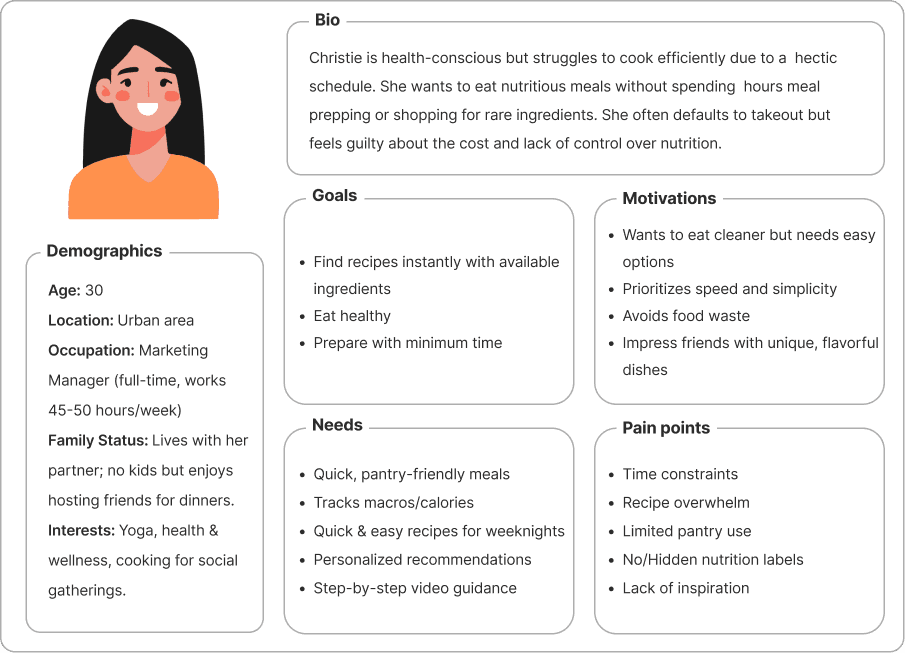
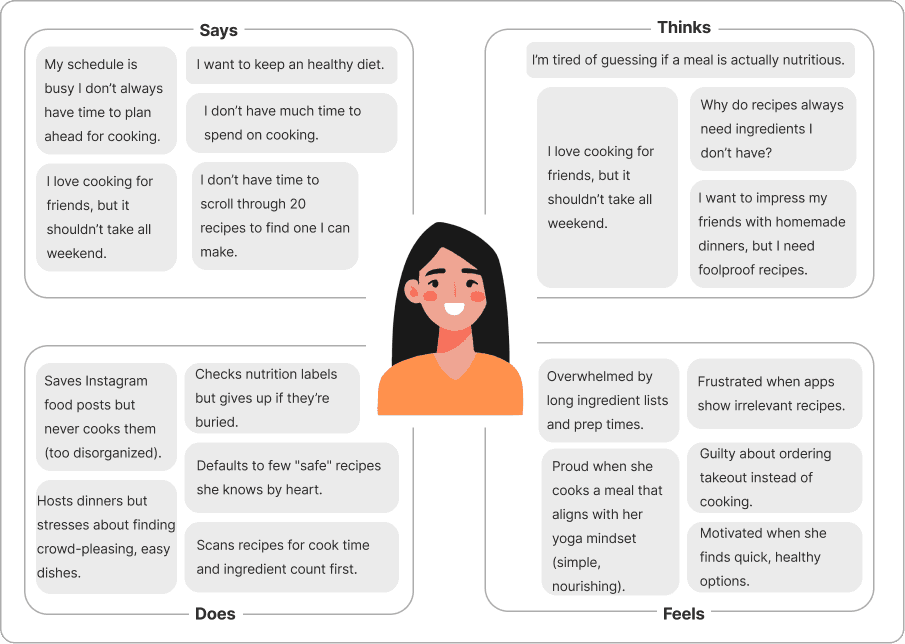
Persona

Spice Up IA
Spice Up IA
Spice Up IA

Empathy Map

Spice Up IA
Spice Up IA
Spice Up IA

Competitive Analysis

Competitive Analysis

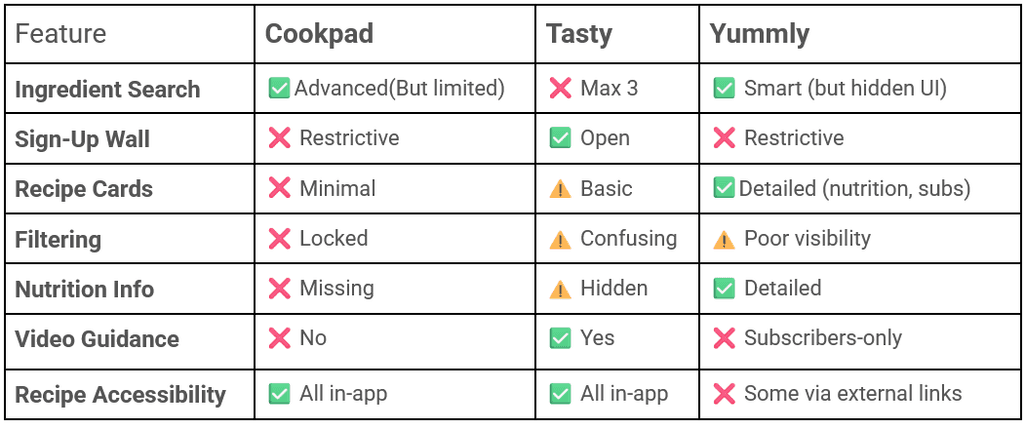
I assessed the top 3 direct competitors, Tasty, Yummly and Cookpad , by gathering the users' reviews and comments on their social media channels, platforms, Play Store, Apple Store, etc to extract strengths and weaknesses of these app based on user’s feedback: 

I assessed the top 3 direct competitors, Tasty, Yummly and Cookpad , by gathering the users' reviews and comments on their social media channels, platforms, Play Store, Apple Store, etc to extract strengths and weaknesses of these app based on user’s feedback: 

Usability Testing with Current Apps

Usability Testing with Current Apps

I also conducted guerrilla usability testing with 5 participants across existing 3 direct competitors IOS apps, presenting them with 3 realistic scenarios. Through observation, I captured their frustrations and pain points to identify key gaps and opportunities in current solutions.

I also conducted guerrilla usability testing with 5 participants across existing 3 direct competitors IOS apps, presenting them with 3 realistic scenarios. Through observation, I captured their frustrations and pain points to identify key gaps and opportunities in current solutions.

Key Gaps in the Market

Key Gaps in the Market

😣Poor Search & Filtering

😣Forced Sign-Ups/Paywalls

😣Lack of Personalization

😣Recipe Accessibility

😣Limited Nutritional Insights

😣Poor Search & Filtering

😣Forced Sign-Ups/Paywalls

😣Lack of Personalization

😣Recipe Accessibility

😣Limited Nutritional Insights

Turning Insights into Actionable Features

Turning Insights into Actionable Features

Turning Insights into Actionable Features

For ideation, I facilitated a Lightning Decision Jam (LDJ) with a collaborator. First, I outlined the app’s core goal and key user frustrations to set the context. Then, we brainstormed features, grouped ideas, and voted on the best ones. Then, I prioritized them using an impact vs. effort matrix which resulted in a set of features to address the findings of the research.

For ideation, I facilitated a Lightning Decision Jam (LDJ) with a collaborator. First, I outlined the app’s core goal and key user frustrations to set the context. Then, we brainstormed features, grouped ideas, and voted on the best ones. Then, I prioritized them using an impact vs. effort matrix which resulted in a set of features to address the findings of the research.

Search by Ingredients Mode

The homepage search bar includes a dedicated mode allowing users to find recipes based on up to 3 ingredients they already have

Dietary Preferences (Accessible to All)

Unlike competitors who gate this feature behind login walls, dietary and allergy filters are freely available to all users as part of the core filtering system.

Meaningful & Intuitive Filtering

Filters are logically categorized and designed with appropriate UI patterns (checkboxes, radio buttons, toggles) to help users quickly distinguish and apply them—reducing time spent searching for the right option.

Informative & Scannable Recipe Cards

Recipe cards display essential decision-making information upfront, optimizing scanability, comparability, and speed in the selection process.

Optimizing Search & Filters for Effortless Recipe Discovery

Optimizing Search & Filters for Effortless Recipe Discovery

Optimizing Search & Filters for Effortless Recipe Discovery

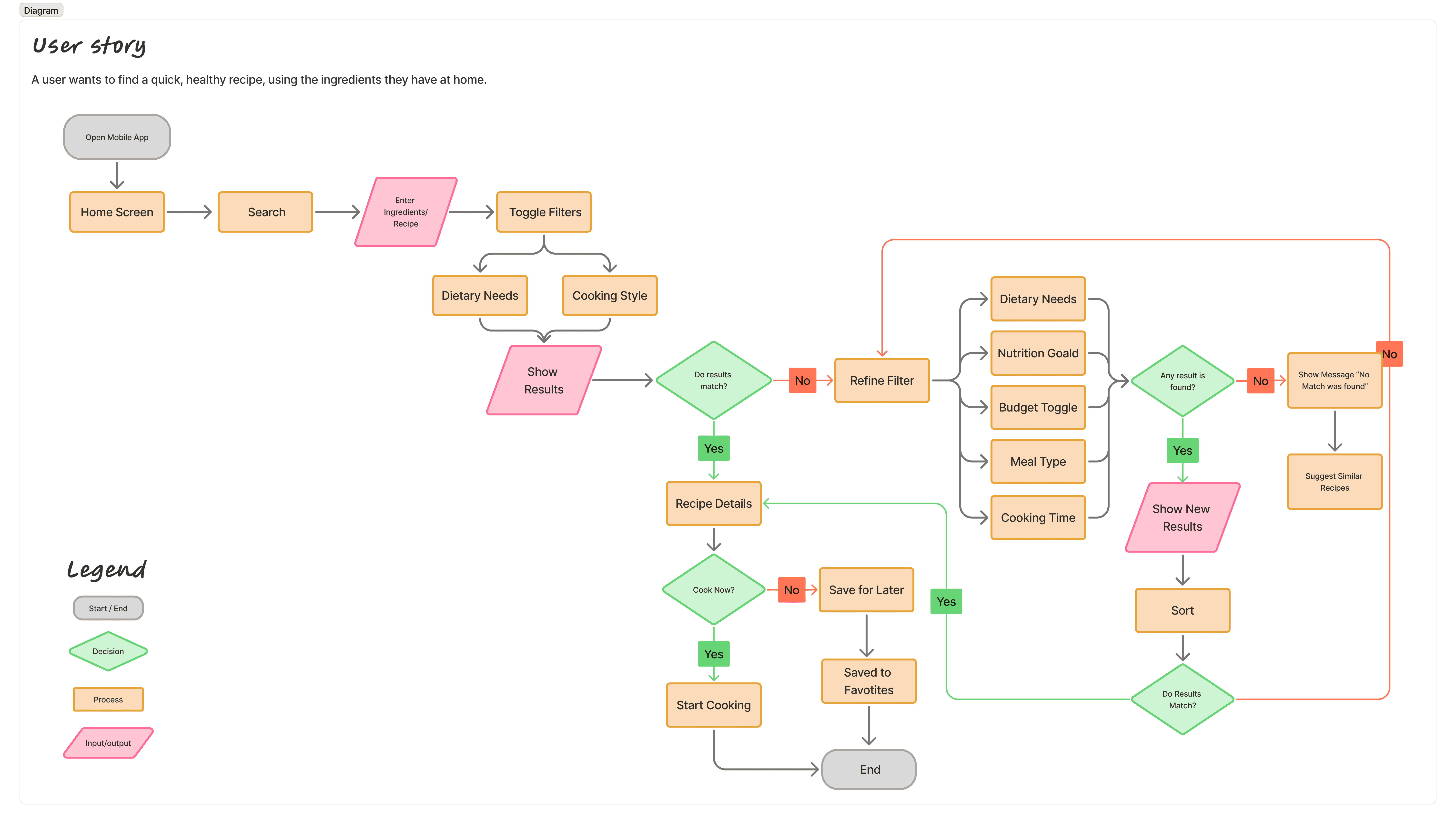
The next challenge was designing an intuitive way to present these features while minimizing friction. After analyzing competitor flows, I focused on optimizing the search and filtering experience with two key goals:

The next challenge was designing an intuitive way to present these features while minimizing friction. After analyzing competitor flows, I focused on optimizing the search and filtering experience with two key goals:

1.Seamless Exploration

Allowing users to freely browse recipes without requiring an account.

  1. Progressive Filtering

    Enabling users to apply essential filters upfront, then refine results further with extended filters after the initial search.
Mid Fidelity Wireframes

Mid Fidelity Wireframes

Mid Fidelity Wireframes

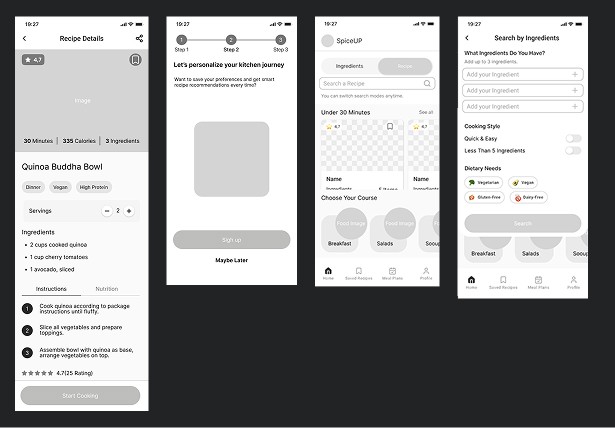
After defining the core features and user flow, I created mid-fidelity wireframes to visualize the layout and functionality of the app.
Usability Testing

Usability Testing

Usability Testing

To conduct early usability testing with a number of users, I developed the following scenarios:

  • Scenario 1: You have two ingredients—quinoa and tomatoes. Find a vegan recipe that is high in protein and the quickest to

  • Scenario 2: Search for a vegetarian omelet recipe that is quick to make and low in carbohydrates. Then, try saving the recipe.

To conduct early usability testing with a number of users, I developed the following scenarios:

  • Scenario 1: You have two ingredients—quinoa and tomatoes. Find a vegan recipe that is high in protein and the quickest to

  • Scenario 2: Search for a vegetarian omelet recipe that is quick to make and low in carbohydrates. Then, try saving the recipe.

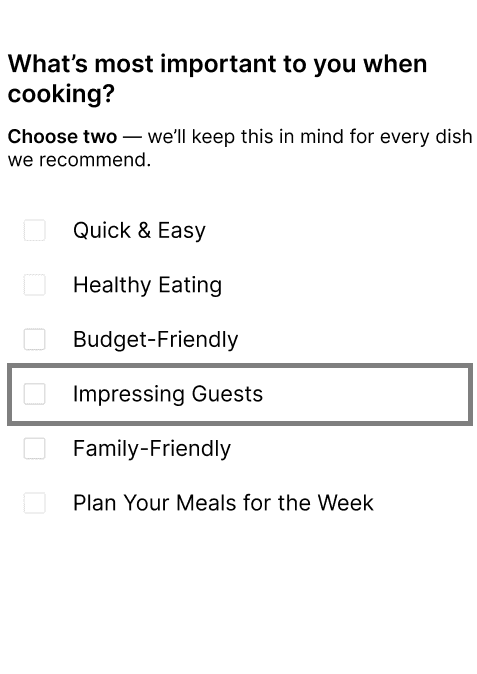
Before
Some microcopy in the onboarding process was unclear and caused confusion for users.
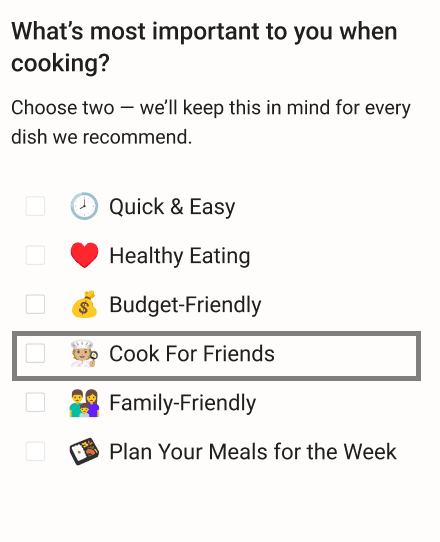
After
I rewrote the microcopy using simpler and more direct language to improve clarity.
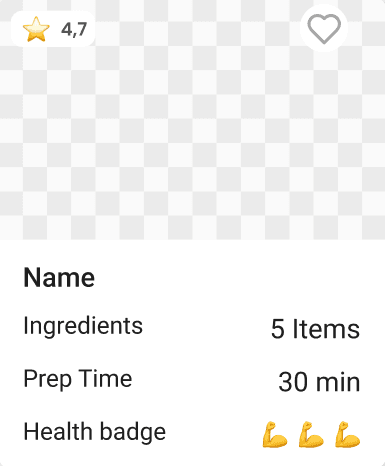
Before
The "Save Recipe" function was represented by a heart icon, which users misinterpreted as a "like" feature rather than a way to save recipes.
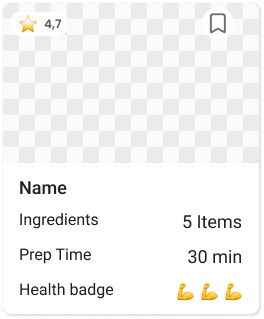
After
I replaced the heart icon with a save ribbon icon to better align with user expectations.
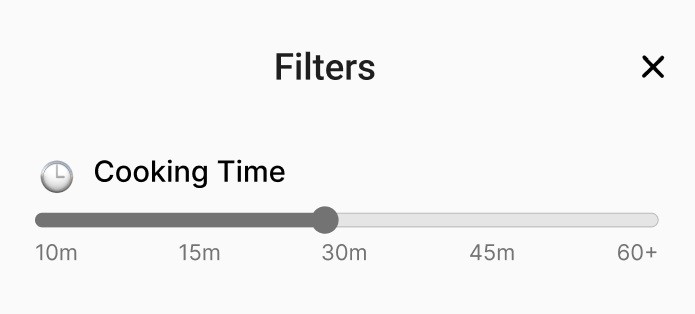
Before
 The cooking timer placed above the filters was often overlooked by users.
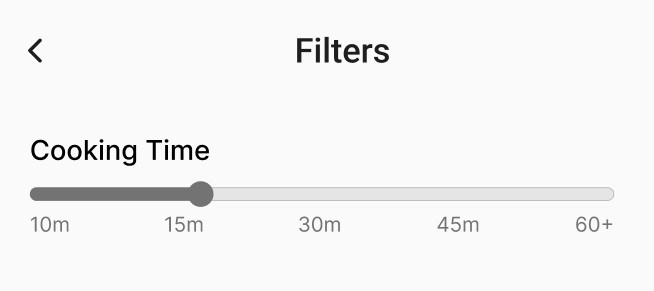
After
I added a timer icon to draw more attention and improve visibility.
Final Design & Mockups

Final Design & Mockups

Final Design & Mockups

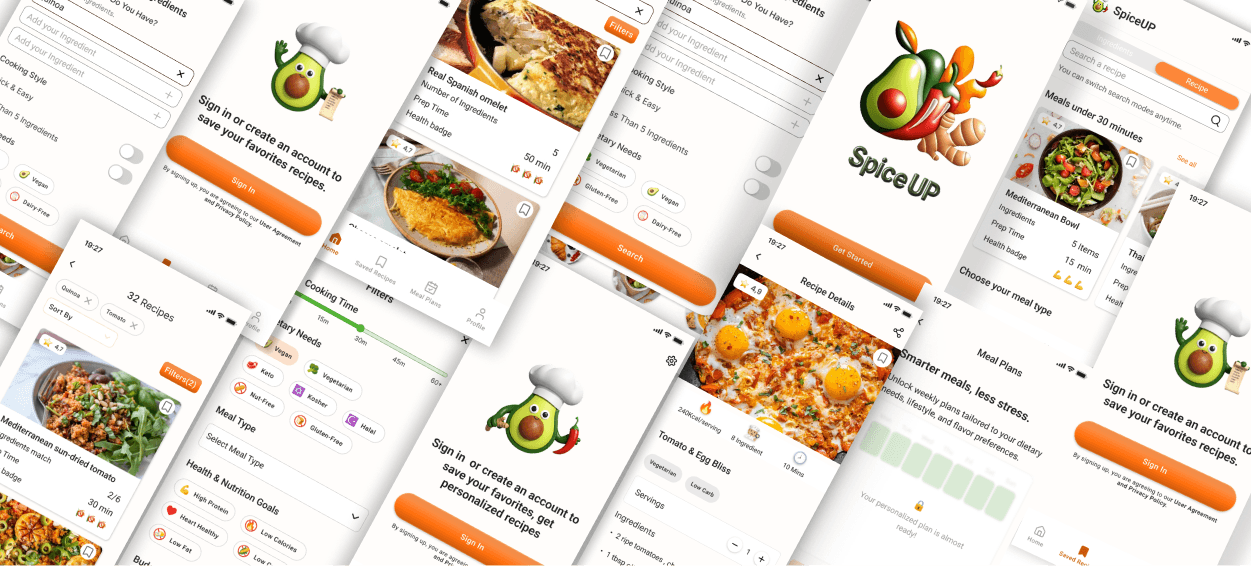
The final design combines user feedback with a sleek, intuitive interface. Users can easily find healthy, quick recipes that match their preferences.

The final design combines user feedback with a sleek, intuitive interface. Users can easily find healthy, quick recipes that match their preferences.

Key Learnings & Challenges

Key Learnings & Challenges

Key Learnings & Challenges

Health Badges Prioritization

Health Badges Prioritization

Each recipe can have multiple health badges like High Protein, Low Calories, or Nut-Free.
Because of limited space, I needed to decide which badges were most valuable to users.
I solved this by researching popular recipe apps, reading nutrition resources, and combining findings with user interview insights.
If this were a real project, I’d explore personalizing badges based on user filters or behavior.

Each recipe can have multiple health badges like High Protein, Low Calories, or Nut-Free.
Because of limited space, I needed to decide which badges were most valuable to users.
I solved this by researching popular recipe apps, reading nutrition resources, and combining findings with user interview insights.
If this were a real project, I’d explore personalizing badges based on user filters or behavior.

Displaying Health Badges

Displaying Health Badges

I tested two approaches: labeled tags for clarity and icons with tooltips for compactness.
Since Spice UP is a mobile app, I prioritized clarity and chose labeled badges so users could instantly understand the meaning without extra interaction.

I tested two approaches: labeled tags for clarity and icons with tooltips for compactness.
Since Spice UP is a mobile app, I prioritized clarity and chose labeled badges so users could instantly understand the meaning without extra interaction.

Balancing User Needs and Business Goals

To keep the app accessible, all recipes and filters are open to everyone.
Advanced features like meal planning and saving recipes are available after login or subscription.
This approach provides a smooth, open experience while supporting future monetization opportunities.

To keep the app accessible, all recipes and filters are open to everyone.
Advanced features like meal planning and saving recipes are available after login or subscription.
This approach provides a smooth, open experience while supporting future monetization opportunities.

Two-Level Flow Balances Speed & Control

Two-Level Flow Balances Speed & Control

Since the app’s main value is searching recipes based on available ingredients, I designed a two-level filtering flow.
Users can add up to three ingredients and set basic filters on the first page, then refine results with extra filters in the next step if needed.
This keeps the process simple at first while giving more control to users who want precise results.

Since the app’s main value is searching recipes based on available ingredients, I designed a two-level filtering flow.
Users can add up to three ingredients and set basic filters on the first page, then refine results with extra filters in the next step if needed.
This keeps the process simple at first while giving more control to users who want precise results.

SpiceUp

Discover healthy recipes in seconds with SpiceUp—the app that makes cooking smarter, using what’s already in your kitchen.

▪UX/UI design ▪ Case study ▪ Personal Project

Challenge : How might we help time-strapped home cooks quickly discover healthy, pantry-friendly recipes?

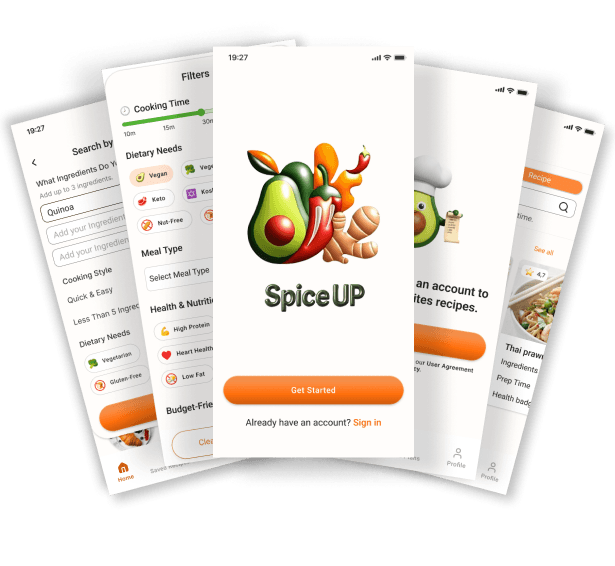
Spice Up Mokup
Spice Up Mokup

Create a free website with Framer, the website builder loved by startups, designers and agencies.